

The T-Shaped Solution
How the team model I wrote about in 2019 and 2021 quietly became the playbook to address today’s “AI value gap”

Every year, the AI story gets louder: bigger budgets, more pilots, more demos.
And then… the same uncomfortable question shows up: “Where’s the value?”
BCG’s global survey captured the mood perfectly: only 26% of companies have moved beyond proof of concept and are generating value. (BCG Global) And even within that group, BCG describes a tiny subset of companies—about 4%—that have built repeatable “AI value engines.”
McKinsey’s 2025 workplace report tells a similar story from another angle: 92% of companies plan to increase gen AI investment over the next three years, yet only 1% say they’re “mature” (fully integrated into workflows and driving substantial outcomes).
If you’ve been following my work since the CFA Institute days, this should feel… familiar.
When I introduced the T-Shaped Team concept in 2019, it started as first-principles reasoning—and it was later sharpened by many generous conversations and real-world examples shared by practitioners around the world.
The premise was simple: investment work and technology work are often orthogonal. Different languages. Different incentives. Different definitions of “quality.” They don’t naturally converge just because everyone is excited about AI.
The part that became clearer over time was just how consistently the same adoption pattern repeated across firms and regions: early promise, scattered pilots, occasional wins—and then a stall when it came time to redesign workflows, build enablement, and make results repeatable.
Again and again, the differentiator wasn’t the model. It was whether the organization had the process and team structure to bridge those orthogonal capabilities—especially the role sitting at the intersection.
That’s what pushed me to go deeper in 2021: the innovation function. Not merely a “translator,” but a role with product ownership for workflows and real leadership potential—because that’s what orthogonal teams actually require to turn pilots into capability.
In the 2019 AI Pioneers in Investment Management report, I argued that adoption failures weren’t primarily about models or tools. They were about climbing a set of organizational hurdles—cost, talent, technology, leadership vision, and time—and then organizing differently to overcome them.
In the 2021 follow-up: T-Shaped Teams: Organizing to Adopt AI and Big Data at Investment Firms, the core claim was blunt:
AI adoption is hard because investment skills and technology skills are “orthogonal,”
so you need a third “innovation” function to connect them.
In other words: the missing ingredient wasn’t “more AI.” It was a better team operating system.
This post is my attempt to connect the dots—between what BCG and McKinsey are warning about now, and what the T-Shaped Team model was designed to solve from the beginning.
The 2024–2025 diagnosis: the value gap is an operating model gap
Let’s put today’s headline stats on the table.
BCG (2024):
Only 26% of companies have moved beyond PoC to generate value.
And the “value engine” group is tiny.
McKinsey (2025):
92% plan to invest more, but only 1% report maturity.
Leaders misdiagnose the bottleneck: the C-suite is 2.4× more likely to cite employee readiness as the barrier than their own leadership alignment, even while employees are already using gen AI more than leaders think.
Employees are telling you what they need: 48% rank training as the most important factor for gen AI adoption, yet nearly half feel under-supported.
McKinsey is explicit that this is not just a tech rollout—it’s an organizational transformation (and it reminds readers that transformations have a poor success rate).
If you strip away the AI branding, these reports are basically describing a classic failure mode:
A tool is introduced, but the organization never rewires workflows, incentives, roles, and decision rights—so pilots don’t scale and value doesn’t compound.
That’s exactly why the T-Shaped Team model exists.
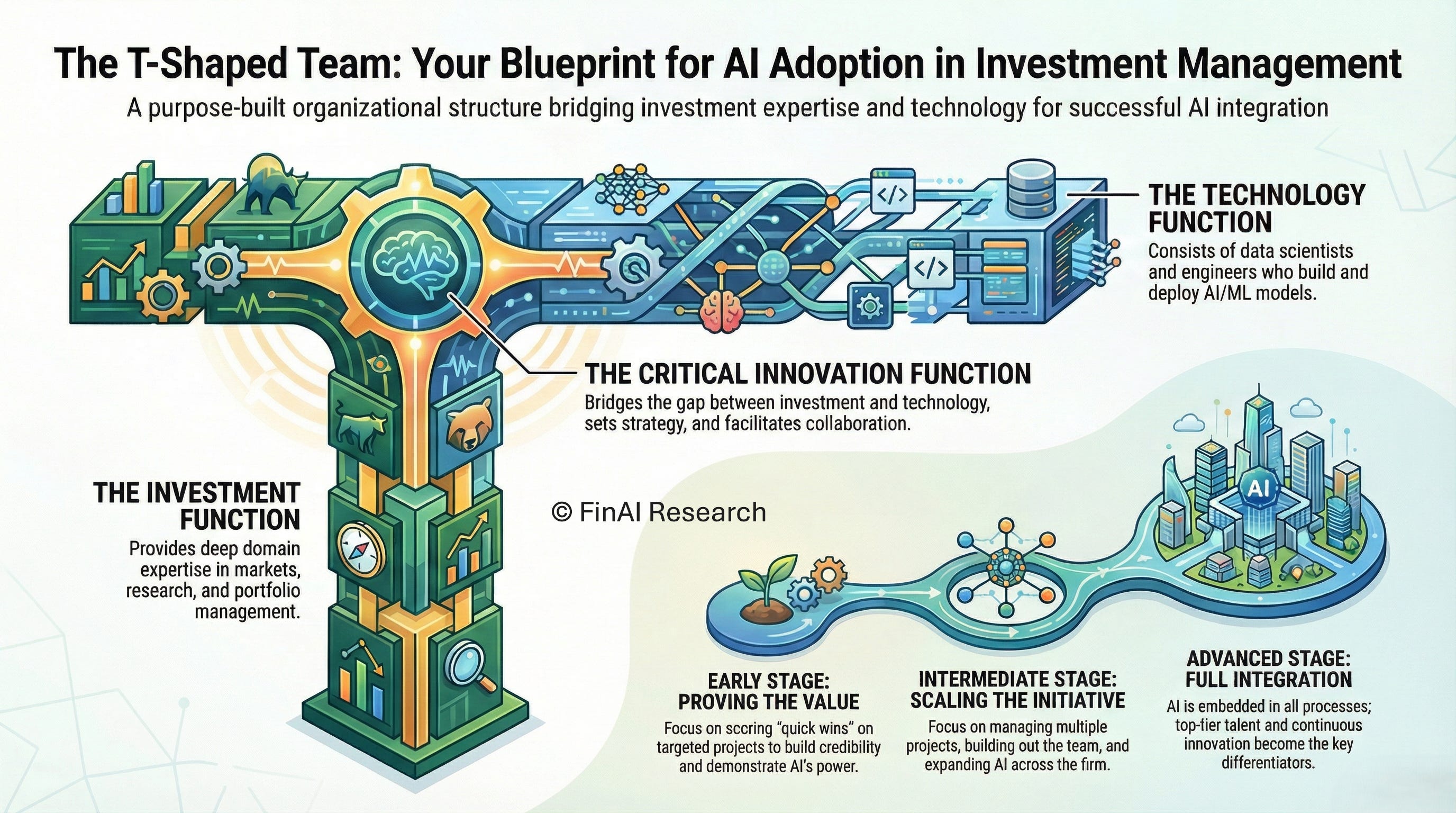
What a T-Shaped Team really is (and what people often misunderstand)
Back in 2019, we introduced the idea that successful firms would be “centered on T-shaped teams” that combine:
domain expertise,
innovation/translation, and
technology application.
In 2021, we clarified something important: T-Shaped Teams are not just “cross-functional teams.”
They’re a specific structure + set of processes designed for one job:
Move AI from interesting experiments to workflow-embedded, measurable outcomes.
The “T” has three parts:
Investment / business function (the vertical)
Owns the real workflow, the decision loops, and what “better” means.Technology / data science function (the horizontal)
Owns the technical delivery: data, models, platforms, MLOps, controls.Innovation function (the connector)
This is the part most organizations miss: the translators, product owners, strategic leaders—the people who can turn “business intent” into “buildable work,” and then back into “adopted capability.”
The innovation function is the antidote to what I see constantly in financial institutions:
Tech teams building “AI artifacts” that don’t land in the investment process.
Investment teams wanting magic with no time, no data discipline, and no change budget.
Many thinking “training” means a lunch-and-learn.
Where the T-Shaped Team directly answers BCG and McKinsey’s warnings
1) The leadership vision gap: “everyone is investing,” nobody is aligned
McKinsey’s report makes the leadership issue explicit—companies aren’t failing because employees refuse; they’re failing because leaders aren’t steering fast enough and aren’t aligning the organization.
In the 2021 report I argued something even more direct:
Leadership vision is the single most important factor to kick-start the process, and senior executives must become champions to ensure a comprehensive AI strategy is developed and implemented.
T-Shaped Teams operationalize leadership vision by forcing clarity on:
Which workflows matter
Where value lies
How risk will be handled
What gets measured
Who owns adoption (not just delivery)
It turns vague ambition into a managed portfolio.
2) The “translation gap”: why pilots die between business and tech
If you’ve ever watched a PoC fail, you’ve seen this movie:
Business says: “We need better decision support.”
Tech hears: “Build a model.”
Nobody owns: “How does this change Monday morning?”
McKinsey has been writing about the need for “analytics translators” for years—people who bridge technical and operational expertise so insights turn into impact at scale. (McKinsey & Company)
Deloitte independently describes the same emerging role: “AI translators” who bridge business and technical staff. (Deloitte)
But the innovation function I describe in the T-Shaped model is more than translation. In practice, these roles behave like product owners of investment workflows: they define the problem, manage tradeoffs, shape adoption, and create the operating rhythm that turns a pilot into a repeatable capability.
And over time, they become something even more valuable: future strategic leaders who can steer the organization precisely because they can think in both domains—and orchestrate across them.
When BCG says few firms reach repeatable value engines, what they’re really pointing at is a missing mechanism for repeatability—the layer that turns one-off wins into a system. And that’s exactly what the innovation function is. (BCG Global)
3) The talent/training bottleneck: your people want to move—help them
McKinsey’s data point is one every leader should sit with:
Training is ranked #1, and people feel under-supported.
In the T-Shaped Team model, training isn’t an HR afterthought. It’s part of the adoption machine—because the whole premise is AI + HI (artificial + human intelligence).
And there’s now strong empirical research showing why this matters:
A major field study of a gen-AI assistant in customer support found meaningful productivity gains (especially for less experienced workers) and improvements in outcomes like sentiment and retention—but only when the tool is deployed into the work and used. (OUP Academic)
Translation: capability doesn’t come from buying the tool. It comes from embedding it into workflows and lifting people into new ways of working. That’s exactly what the innovation function is supposed to do.
4) The “star” trap: early success that never becomes an advantage
In practice, early AI progress is often driven by heroic individuals—one PM who codes, one quant who can talk to the business, one data scientist who “gets it.”
Our 2021 report calls this out: early efforts are often driven by individuals with T-shaped skills, but that’s a pre-T-shaped team stage and has a poor chance of producing sustainable advantage.
McKinsey’s “1% maturity” statistic is the enterprise version of the same message: lots of activity, little institutionalization.
T-Shaped Teams are how you turn:
isolated competence → organizational capability
ad hoc pilots → repeatable delivery + adoption
scattered tools → workflow-integrated systems
Closing thought: the “AI value crisis” is not new—only the spotlight is
When AI Pioneers came out in 2019, I was already describing the industry moving off the “peak of inflated expectations” and into the harder work of implementation.
BCG and McKinsey are now documenting that same hard truth at enterprise scale:
Investment is easy.
Demos are easy.
Value is organizational.
T-Shaped Teams are not a trendy metaphor. They are a practical answer to the exact bottlenecks the biggest firms are now publicly diagnosing.
And the organizations that treat “team design” as seriously as “model selection” will be the ones that turn AI from spend into compounding advantage.
Further reading (the sources behind this post)
BCG, Where’s the Value in AI? (2024) (BCG Global)
McKinsey, Superagency in the Workplace (2025)
Larry Cao, AI Pioneers in Investment Management (2019), CFA Institute
Larry Cao, T-Shaped Teams (2021), CFA Institute,
Deloitte on “AI translators” (Deloitte)
Evidence on productivity impacts of gen AI at work (OUP Academic)